Royal Institute of Art in Stockholm
Critical Images 2018/2019
https://www.academia.edu/39661641/CRITICAL_IMAGES_2018_19
BREAKING THE FRAME
Experience of erasable subjectivity
In 2017, I worked on a documentary film entitled “Learning Greece” that focuses on educational initiatives that support migrant communities in Greece. At that time, over 60,000 people, who hoped to reach Western Europe in search of asylum, were stuck in Greece as a result of borders closures of several Balkans countries and Hungary in 2016. The situation was dire. A country drained by nearly a decade of economic crisis, struggling to provide accommodation and basic services, not to mention, long term solutions. Alongside the failure of the authorities, I observed an outburst of grassroots solidarity. Due to their long experience of austerity, Greeks were forced to innovate, and developed alternative ways of supporting each other. There were many grassroots initiatives and small organizations led by locals and international volunteers that offered various kinds of humanitarian support, including within the field of education. Many of these initiatives were inventive, inspiring, exceptional, and – I believed – worth sharing with the world.
At this point, however, only two years after the “refugee crisis” hit the headlines, media and public attention had drifted away and there was no more demand for stories from Greece. Nevertheless, I was determined to tell this story and I wanted to reach a wider audience. I calculated the best ways to reach this goal. The idea of the film was to present a variety of challenges, approaches, and methods which in the end comprised of four different educational projects. A repetitive narrative pattern was implemented at each project shooting: lesson scenes with original, dynamic sound, an interview with a teacher, an interview with one or two students. I endeavored to create a balance between informative objectives, personal stories and dynamic, lively scenes.
Despite my optimistic expectation and all the effort I put into the production, there was little interest in the film. In 2015, photograph of Alan Kurdi triggered public outcry and political decisions. Calls for solidarity were coming from various sides, warm clothes and funds were collected, and volunteers from all over the world took off for Greece and Balkan countries in order to support people on the move. I was one of the many volunteers.
But empathy resources of Europeans seemed to be overstretched. “Compassion is an unstable emotion. It needs to be translated into action, or it withers”[1]. With no solution in sight, in a matter of months things began to change; alarming voices become more vocal and the rhetoric around migration to Europe turned away from humanitarian towards security issues. Solution driven and balanced reporting became superfluous in the increasingly polarized discourse.
Populist politicians took advantage of this. Although Poland was far away from migration trails and in no way was a destination, duringa parliamentary campaign at the end of 2015, refugees were used to scare voters and to gain support. It was a success. The governing Law and Justice party continued with their hard stance on immigration policies, they refused to grant asylum to a single person despite the relocation agreement signed by the previous government (relocation of 7000 to 38.000 population country). Opinion polls show that the number of Poles against accepting asylum seekers from war-torn countries had doubled within a few months[1].
In Poland, asylum seekers and migrants were an imaginary threat, phantom entities and, therefore, it required creating stories and visual representation to maintain fear-based narration[2]. Images played a huge role in building hostile attitudes. The most commonly depicted were big groups or crowds of single men, portrayed as invaders. Distinctive visual features, the difference between “us and them”, created the figure of an enemy. The people, who came to Europe in search of safety, were described as “terrorist”, “invaders”, “rapists”, “strangers” who transmit diseases. The narrative revolved around their inability to become one of us; therefore all necessary measures have to be taken to protect the host societies (at best they could be treated as an economic asset). Such a narrative deprived of dignity and degraded their rights, and therefor their suffering and their legitimate need for protection were questioned. In this narrative, the Polish Catholic society was in a vulnerable position and required protection. Polish politicians and hence Polish society became hostile towards asylum seekers so this negative imaginary pattern depicting flight may not be so sharp in other countries, but is surely no exception.
Framing spectrum of distant strangers is diverse and includes various narratives. As the opposite to those which demonize, there are images that call for compassion and aim to create empathy in the name of humanitarian values. The asylum seeker is constructed as an object in need of hospitality, he/she is passively waiting to be welcomed. This way of portraying also deprives of agency and helps create sufficient distance. Poor and hungry people living in miserable conditions cannot be confused with members of the host society. The relation between us and them is always conditioned and hierarchical.
There are exercises that oppose to this discriminative gaze which aim to escape perpetuating stereotypes and categorization. There are image-makers who actively search for a fair way to represent people on the move while respecting their agency and dignity. This is also my struggle as I was appalled by what I’ve observed in Polish media. As a filmmaker, I would like to contribute in a more accurate and respectful way to media landscape and discussions on migration. When I initially approached this topic I believed that I would be able to give individuals who have fled to Europe platform to transmit their own voice through filmmaking tools. My enthusiasm has gradually declined. I have realized that, despite all the efforts, representing and seeing an individual person and individual story is very hard, if not, impossible.
The notion of identity has recently become one of the most significant points of reference to determine the trajectory of political and social relationships. The compound of ethnic, racial, cultural and religious identities seems to entitle groups to claim a superior position to those who are marginalized or excluded on the basis of perceived group differences. It severely affects those who are excluded; degrading their status and dignity. “The human rights charters tell us that dignity is inherent in the human person; they also command us to make heroic efforts to establish everyone’s dignity. Is this an equivocation?”[1] asks Jeremy Wardon reflecting on human dignity as a notion of legal and moral order and its dependence on variety of limitation and circumstances. Throughout history, dignity was related to rank and status and modern hope expressed in various conventions and declarations strive to make dignity an unconditional, universal status is questioned. Identity based narratives create simplistic explanations in order to justify a hierarchy of rights and discriminative practices based on an imposed order.
Images are significant elements of shaping discourse and atmosphere, and as a filmmaker I feel responsibility for contributing to circulation of visual story telling. Unfortunately, the more I work with disfavoured groups, the more I feel paralyzed. How can image-producers get out of a daunting task of expressing nuanced stories and voices when everybody becomes labelled in the top-down imposed category? How is it possible to represent an individual or a group that is excluded on the basis of widely accepted notion of identity and the hierarchical distribution of dignity?
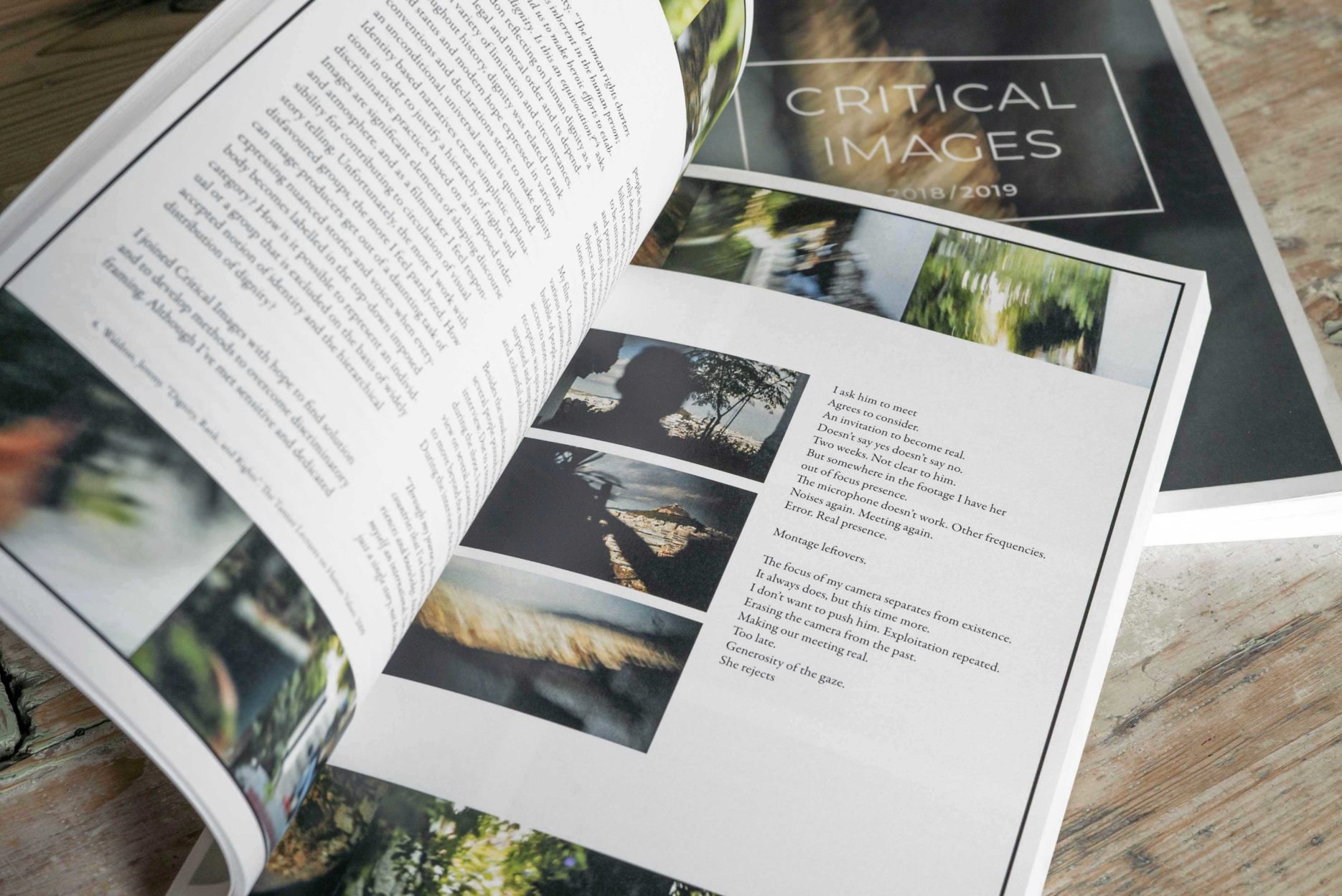
I joined Critical Images with hope to find solution and to develop methods to overcome discriminatory framing. Although I’ve met sensitive and dedicated people in the group, our discussions and exercises only deepened my concern. I cannot see the possibility to escape from the western gaze, which aspires to be universal. The West produces the knowledge and posses all component narratives. Those, who are identify as outsiders occupy the position of the object, and individual attempts to break this narrations are doomed to failure.
My film “Learning Greece” has been screened on various occasions, mostly in the so-called social bubble of people supporting solidarity actions, as access to more varied public has been limited. Its reception was quite positive. The audience was surprised and inspired by the difficult yet vibrant and colourful solidarity life in Athens.
Besides the usual reactions during the screening, several people pointed to one particular student interview. Due to a recurrent technical failure during the shoot, I was forced to conduct the interview on several occasions, which led the discussion to move beyond the main topic; education.
During the interview, the student said: “Through my journey, through all the different countries that I’ve been to, I gained so many experiences and knowledge. And that’s why I consider myself an international. Not a refugee. “Refugee” is just a single story, not the whole of who I’m”.
[1] Waldron, Jeremy. “Dignity, Rank, and Rights”. The Tanner Lectures on Human Values. 2009
[1] Bachman, Bart “Diminishing Solidarity: Polish Attitudes Toward The European Migration And Refugee Crisis”. Migrationpolicy.Org. 2016
[2] Klaus, Witold, New Right-Wing Government in Poland and its Policy Towards Immigrants and Refugees, Institute of Law Studies, Polish Academy of Sciences, Poland, 2017
[1] Sontag, Susan. Regarding the Pain of Others, Suffolk, England, 2004